


New diverted routes to supply Europe
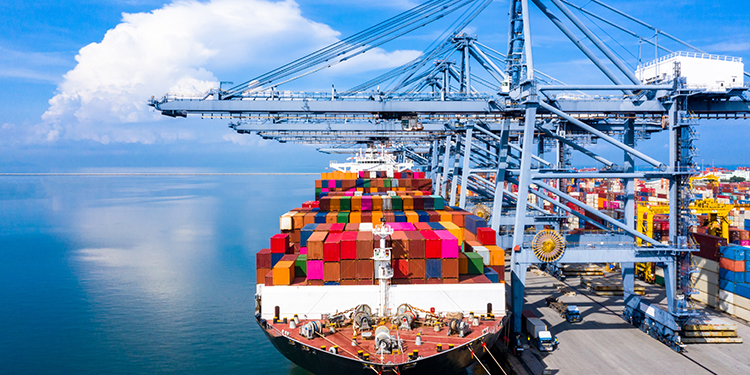
Since the closure of Dubai airport to freight and the de facto blockade of the Strait of Ormuz, Europe is once again discovering what it means to depend on a few bottlenecks for its imports. Logisticians, on the other hand, are working to urgently redraw a flow map where the Gulf is no longer the obvious pivot of globalization.
Dubai was not only a regional hub: it was the hub of a Europe-Golfe-Africa/Asia triangular trade, especially for cosmetics, pharmacy, automobile and French luxury. With the closure of Ormuz Strait, 84 per cent of this bridge trade is brutally cut, leaving docked containers and strategic stocks outstanding.
Ship diversions around Ormuz jumped by more than 360 per cent, from an average of about 218 detours per day to over 1,000, according to real-time tracking data. At the air level, the paralysis of the large Gulf hubs (Dubai, Doha, Abu Dhabi) and the partial closure of airspace transforms previously direct roads into labyrinths bypassing the Iranian crisis arch.
For maritime freight to or from Europe, the most visible consequence is the return in force of the "great bypass" by the Cape of Good Hope. Unable to pass either through Ormuz or the Red Sea or through Suez, some ships now have to extend their journey by several thousand miles through Africa. Timelines are exploding and fuel overloads are following.
In the Gulf itself, a mapping of ports is recomposed. The flows formerly concentrated on Jebel Ali or Hamad are diverted to a handful of ports capable of absorbing this shock: Khawr Fakkan in the Emirates, Sohar in Oman, Hambantota in Sri Lanka or some major Indian ports like Mundra or Navi Mumbai. These platforms become temporary hubs, at the cost of spectacular congestion and delays of up to seven weeks on some Asia-India-Europe routes.
Over the last thousands of kilometres, the road and, more marginally, the rail try to take over. Small ports east of Ormuz, Sohar, Khor Fakkan, Fujairah and Jeddah in the Red Sea become regional entry points. From there, the goods complete their journey by truck or, when infrastructure exists, by rail to the Gulf markets, thus bypassing the maritime lock.
Logisticians are now talking about intra-regional "landbridges": land corridors linking these new hubs to markets previously fed directly via Dubai or Doha. The manoeuvre is costly, vulnerable to border tensions and dependent on limited road capacity, but it avoids a complete disruption of supply for landlocked countries in the Gulf.
In the sky, the maps are just as shaken. The closure of several airspaces in the Middle East obliges the companies to draw two major bypass routes between Europe and Asia.
In the north, the road passes through Turkey, the Caucasus and Central Asia, largely favoured by European carriers who thus avoid the Gulf. Istanbul is a major hub for passenger and cargo traffic, despite an increase in flight time from 1h30 to 3h depending on Asian destinations. In the south, another option bypasses the Arabian Peninsula by Egypt, the Red Sea and then India, extending flights from two to three hours and significantly increasing the cost of fuel to the airlines.
In parallel, other hubs are positioned as alternatives: Addis Ababa, Singapore, Helsinki, or even some Asian hubs using roads via Russia or the North Pole, where overflight rights allow. This network of rescue solutions draws a fragmented sky, where the optimal routes d'hier give way to a mosaic of geopolitical and economic compromises.
Globally, Ormuz Strait accounted for only about 2% of containerized traffic, according to analysts. But these 2 per cent were irrigating very specific segments of the value chain: industrial components, chemicals, household appliances, furniture, textiles, cosmetics and agri-food products from the India-China-Oceania axis.
For Europe, the cut-off « secondary pipe » added to roads already weakened by attacks in the Red Sea, the war in Ukraine and the closure of the Russian sky to European companies. Importers are now multiplying the scenarios of decline: shifting volumes to Asia via alternative hubs, diversifying suppliers outside the Gulf zone, rebuilding buffer stocks and even partially relocating certain productions.
There is no indication that these bypass routes will become the new standard. But they reveal a heavy tendency, namely the end of the illusion of fluid and linear globalization.